
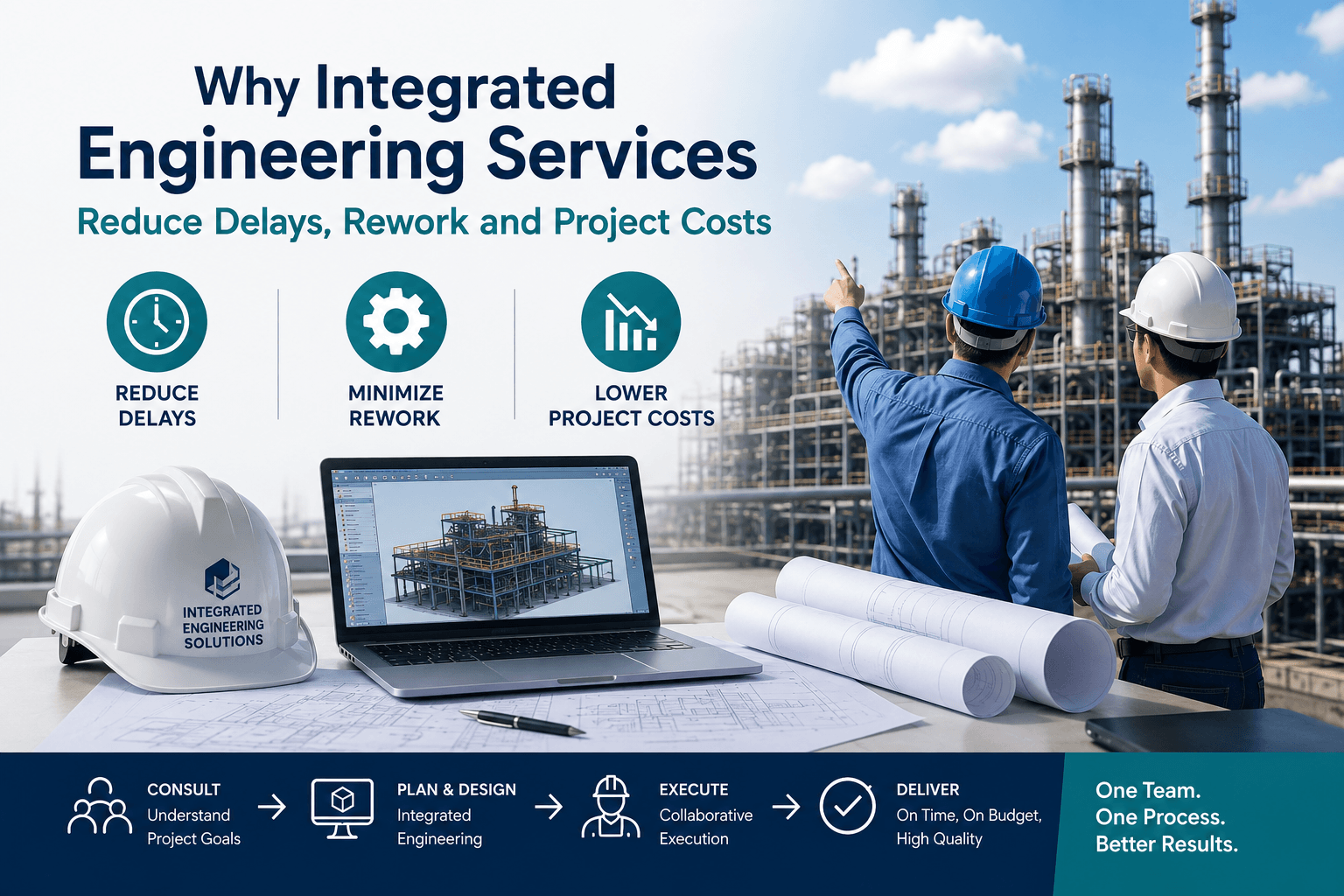
There’s a particular kind of chaos that only shows up on projects run by too many separate hands. The civil firm blames the mechanical firm. The mechanical firm blames whoever drew the layout. Nobody’s quite wrong, and yet the beam still runs straight through the pipe route, and now everyone’s standing on site arguing about who pays to fix it. If you’ve ever watched an industrial project unravel, you’ve probably watched it unravel right here, in the gaps between the specialists.
That’s the hidden cost of fragmenting a project. When you hand the design to one firm, the structural work to another, and the project management to a third, and hope they’ll all talk nicely to each other, you’ve quietly made yourself responsible for stitching their work together. And the seams are exactly where things tear.
The problem with handing your project round in pieces
On paper, hiring separate specialists looks smart. Best civil people, best mechanical people, best electrical people, all picked individually. What could go wrong? Plenty, as it turns out, because a project isn’t a stack of separate disciplines. It’s one thing, and every part of it connects with the other.
The trouble is that separate firms optimize for their own scope, not the whole. The structural team designs the most elegant structure. The piping team designs the cleanest pipe runs. Neither is looking at the other’s drawings until it’s too late, and when their two elegant solutions collide, someone has to give. That someone is usually you, discovering the clash on site, paying for the rework, and losing weeks to a problem that should have been caught on a screen months earlier.
This is precisely the mess that Integrated Engineering Services India exists to prevent. When every discipline sits under one roof, working from one shared model, the clashes get found and fixed while they’re still cheap lines on a drawing rather than expensive steel already welded into place.
One team, one version of the truth
The real magic of an integrated approach isn’t the org chart. It’s that everyone is working from the same information at the same time. Half the rework on fragmented projects comes not from anyone being incompetent but from people working diligently off outdated or mismatched information. Kill that, and a huge slice of the delay and cost simply never happens. Serious industrial engineering Consultants India build their whole way of working around this idea because they’ve seen what the alternative costs.
Coordination stops being your problem
When you split a project across many firms, coordination becomes your job by default. You’re the one chasing the structural firm for the drawings the mechanical firm needs. You’re the one refereeing when they disagree. You become an unpaid, under-qualified project manager for a project you hired professionals to handle.
An integrated industrial project management consultancy India takes that weight off you entirely. The coordination happens inside the team, invisibly, as part of the normal work rather than as a series of tense emails you have to send. The good project management consulting firms in India treat this internal coordination as their core value, not an add-on, because they know it’s where projects are actually won or lost.
The whole lifecycle, joined up
Fragmentation doesn’t just hurt within a single stage. It hurts across the industrial project lifecycle too, at every handover from one phase to the next. Concept passes to detailed design further to procurement then to construction, and every handover between different firms is a chance for something to fall through the crack.
An integrated partner like Shah & Talati offers a concept to commissioning services India and carries the project through those transitions without dropping anything, because the same team that made the early decisions is still there to honor them later. The intent behind a design doesn’t get lost in translation because there’s no translation, just one continuous team who remembers why things were done the way they were. That continuity is exactly what fragmented delivery can never offer.
Where the savings actually come from
Let’s be concrete about the money, because that’s what owners care about. Integrated delivery saves cost in three quaint ways.
First, rework. Clashes caught on a shared model cost an engineer’s afternoon. The same clashes caught on-site cost material, labour, and delay. Strong, detailed engineering services India delivered by an integrated team, catch these problems while they’re still cost-effective. Second, schedule. When disciplines work in parallel from shared information instead of waiting on each other’s finished drawings, the whole timeline compresses, and time is money on every industrial project. Third, the quality of the final asset. A plant designed as one coherent whole, with the civil, structural, and mechanical all genuinely coordinated, runs better and lasts longer than one bolted together from separate visions. That’s the enduring value good civil and structural engineering consultancy India adds when it’s part of an integrated whole rather than a solo.
Conclusion
None of this means specialists don’t matter. Of course they do. Youa still want brilliant structural engineering consultants India and sharp industrial architects in India on your project. The point is that their brilliance is worth far more when it’s coordinated than when it’s scattered across firms.
The engineering and project management consultants India worth hiring understand that the value was never just in the individual disciplines. It was always in how well they fit together. Fragment the work and you inherit every gap between the pieces. Integrate it, and those gaps simply close, taking the delays, the rework, and a good chunk of the cost quietly with them.